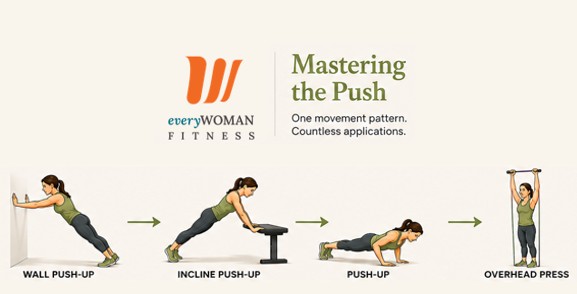
The Push Family of Exercises
Pushing is a fundamental movement pattern we use every day: from getting off the floor to opening heavy doors and lifting objects overhead. Learn how horizontal and vertical pushing exercises relate, why they matter for strength and independence, and how to progress safely as your abilities grow.
We use pushing movements every day, often without thinking about it.
You're using the push movement pattern when you:
Stand from a chair using the armrests
Open a heavy door
Guide a lawn mower across the yard
Place a heavy box onto a shelf
Move furniture across a room
The push is one of the fundamental movement patterns that allow us to interact with the world. Like the squat and hinge, pushing exists on a spectrum. Whether you're performing a wall push-up or pressing a barbell overhead, you're training many of the same muscles and teaching your body to produce force in coordinated ways.
Understanding the push family makes strength training feel less intimidating because individual exercises become variations on familiar movement patterns rather than a collection of unrelated exercises.
What Is a Push?
A push occurs whenever you generate force away from your body to move something. It also occurs when the object or surface stays put and your body moves instead: pressing against a bench to help yourself stand, rising from the floor with assistance from your arms, or planting ski poles into the snow to propel yourself forward.
Depending on the task, that force can be directed in different ways:
Horizontally, such as during a push-up or chest press.
Vertically, such as during an overhead press.
In all cases, the muscles about the shoulders, elbows, and shoulder blades work together while the trunk provides a stable foundation from which to generate and transfer force.
If you read last week's resource on the Squat Family, you may recognize a familiar concept here. A squat is essentially a lower-body push: the legs generate force against the ground to move the body upward. Movement families overlap, which is one reason understanding these patterns can make strength training much more intuitive.
The primary muscles involved in upper-body pushing include:
Pectoralis major (chest)
Deltoids (shoulders)
Triceps
Serratus anterior
Rotator cuff muscles
Core muscles that stabilize the trunk
Different pushing exercises emphasize these muscles to varying degrees, but they all train the body to generate and transfer force through the upper body.
Why the Push Matters
I addition to allowing us to interact with, and function in the world, pushing exercises contribute to lean upper-body muscle mass and provide loading through the arms and shoulders that can help support bone health.
And pushing shouldn't exist in isolation. A well-rounded strength program includes both pushing and pulling movements, developing strength around the shoulder in multiple directions. We'll explore the other half of that equation in our Pull Family resource.
The Push Family
Rather than one single progression, think of the push family as two closely related branches.
Horizontal Push
Most horizontal pushing exercises fall along a simple progression:
Wall Push-Up: teaches alignment and pressing mechanics while reducing the amount of body weight being moved.
Counter Push-Up: gradually increases the load while preserving the same movement pattern.
Floor Push-Up: the classic bodyweight pushing exercise, requiring coordinated strength through the chest, shoulders, triceps, and trunk.
Dumbbell Chest Press: allows greater loading while each arm works independently.
Barbell Bench Press — appropriate for those whose goals include maximizing upper-body strength.
What about knee push-ups? They can certainly be useful, but we generally prefer progressing by changing the height of the supporting surface. This preserves the full-body mechanics of a push-up while allowing the load to increase gradually.
Vertical Push
Vertical pushing directs force overhead. Examples include:
Sitting overhead press: teaches the mechanics of moving objects above our heads without having to focus on body position.
Standing dumbbell overhead press: builds on the seated version, bringing real functionality to the move.
Banded squat to overhead press: combines upper and lower extremity presses into one critical movement used in heavy daily activities.
Triceps dips: helps us propel ourselves out of chairs, which may be critical for us 30 years from now.
These exercises develop shoulder and arm strength while requiring the trunk to provide a stable base underneath the moving load.
What about Diagonal or Oblique Pushing?
Of course, real life rarely asks us to push only straight forward or directly overhead. Many activities combine elements of both. Driving ski poles into the snow, completing a sword draw movement, or pushing a heavy object uphill all produce force along a diagonal.
Mechanically, these movements aren't a separate family so much as a combination of horizontal and vertical pushing. They also ask the trunk and lower body to help generate and transfer force, reminding us that everyday movement rarely isolates one pattern at a time.
Which Push Exercise Is Best?
There isn't one "best" push exercise.
The right choice depends on your experience, goals, current strength, shoulder mobility and comfort, and what you have available to use. Fortunately, effective pushing strength can be developed with everything from a wall or countertop to dumbbells, resistance bands, or a fully equipped gym.
A wall push-up can provide an excellent strength challenge for someone beginning resistance training. A floor push-up may be ideal for another person, while someone interested in maximizing strength may choose progressively heavier presses.
What matters most is selecting a variation that allows you to move with good control and then gradually increasing the challenge as you become stronger.
Our Perspective
At Every Woman Fitness, the goal isn't to master a particular push exercise but rather, to build useful pushing strength and continue challenging it as your abilities grow. The ultimate goal is allowing our bodies to function efficiently in all the daily tasks we must complete and the adventures we want to enjoy.
For one person, that may mean progressing from the wall toward a floor push-up. Someone else may enjoy working toward heavier dumbbell or barbell presses. Both can build the strength needed to handle everyday tasks, rise from the floor, participate in sports and recreation, and remain physically capable over time.
As always, we begin with quality movement, then gradually add challenge as strength improves.
PT Perspective
Shoulder discomfort doesn't automatically mean pushing exercises need to disappear from your strength program.
Sometimes a different variation, smaller range of motion, lighter load, or change in technique can make a movement more comfortable. When appropriate, finding a well-tolerated way to load the shoulder can be more useful than eliminating pushing altogether.
Persistent, worsening, or unexplained shoulder pain deserves evaluation rather than simply training through it. Nikki freely admits she's biased after more than 25 years as an orthopedic physical therapist, but persistent joint pain is a good reason to seek an evaluation rather than simply pushing through it or living with pain.
References
Currier BS, D'Souza A, Fiatarone Singh MA, et al. American College of Sports Medicine Position Stand. Resistance Training Prescription for Muscle Function, Hypertrophy, and Physical Performance in Healthy Adults: An Overview of Reviews. Medicine & Science in Sports &Exercise. 2026;58(4):851-872.
American College of Sports Medicine. ACSM's Guidelines for Exercise Testing and Prescription. 12th ed. Philadelphia, PA: Wolters Kluwer; 2025.
Suchomel TJ, Nimphius S, Stone MH. The Importance of Muscular Strength in Athletic Performance. Sports Medicine. 2016;46:1419-1449.
Nelson ME, Rejeski WJ, Blair SN, et al. Physical Activity and Public Health in Older Adults: Recommendation from the American College of Sports Medicine and the American Heart Association. Medicine & Science in Sports & Exercise. 2007;39(8):1435-1445
Ludewig PM, Reynolds JF. The Association of Scapular Kinematics and Glenohumeral Joint Pathologies. Journal of Orthopaedic & Sports Physical Therapy. 2009;39(2):90-104.
Kibler WB, Sciascia A. Current Concepts: Scapular Dyskinesis. British Journal of Sports Medicine. 2010;44(5):300-305.