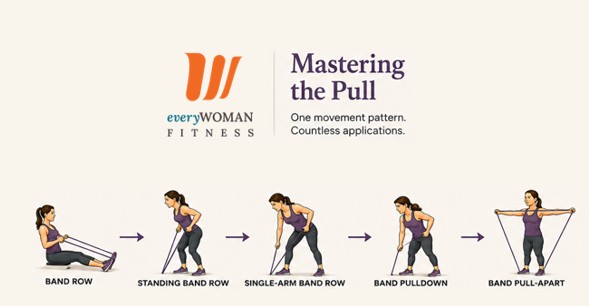
The Pull Family of Exercises
Pulling is a fundamental movement pattern we use every day, from opening heavy doors and gardening to paddling, climbing, and carrying gear. Learn how horizontal and vertical pulling exercises build useful upper-body strength and how the pull family fits into everyday movement.
We use pulling movements every day, often without thinking about it. As we age, activities that require pulling may become more challenging. You’re using the pull movement pattern when you:
Open a heavy door.
Move wet laundry out of the washing machine.
Weed the garden.
Drag a suitcase across uneven ground.
Pull yourself up using a handrail.
Row a kayak or canoe.
Like the push, the pull is one of the fundamental movement patterns that allows us to interact with the world. Whether you’re performing a seated row with a resistance band or pulling yourself over a rock on a hike, you’re training your body to generate force while working against resistance.
Understanding the pull family helps simplify strength training. Instead of seeing dozens of unrelated exercises, you can begin recognizing variations of the same basic movement pattern.
What Is a Pull?
A pull occurs whenever you generate force to bring an object toward your body or bring your body toward an object.
Depending on the task, we can generally think of that force as being directed in one of two ways:
Horizontally, such as during a rowing exercise.
Vertically, such as during a pull-up or lat pulldown.
These categories aren’t perfect, nor do they need to be. In both cases, the shoulders, elbows, and shoulder blades work together while the trunk provides a stable foundation from which to generate and transfer force.
Like the push family, the pull also overlaps with other movement patterns. Pulling a heavy object from the floor, for example, may combine an upper-body pull with a hip hinge. Climbing can combine pulling, pushing, balance, and lower-body strength all at once. Real-world movement rarely isolates a single pattern.
The primary muscles involved in pulling include:
Latissimus dorsi
Rhomboids
Middle and lower trapezius
Posterior deltoids
Biceps brachii
Rotator cuff muscles
Core muscles that stabilize the trunk
Different pulling exercises emphasize these muscles in different ways, but they all develop our ability to generate and transfer force through the upper body.
Why the Pull Matters for Women Over 40
Pulling strength helps with tasks that require us to move objects toward us, hold them close, climb, or control loads with the upper body. It also plays an important role in recreational activities from paddling and skiing to climbing and gardening.
Just as importantly, pulling exercises strengthen many of the muscles that stabilize and move the shoulder blades. Along with pushing exercises, they help develop balanced strength around the shoulder and support comfortable movement during everyday activities.
For women over 40, pulling exercises also contribute to the overall strength-training stimulus that supports muscle, bone, and long-term physical function.
The Pull Family
Rather than one single progression, think of the pull family as two closely related branches.
Horizontal Pull
Most horizontal pulling exercises follow a fairly simple progression:
Standing Band Row: An excellent starting point that teaches posture, shoulder blade control, and reaching mechanics.
Seated Resistance Band Row: Allows progressively greater loading while reinforcing coordinated pulling mechanics.
Single-Arm Dumbbell Row: Develops strength while each side works independently.
Chest-Supported Dumbbell Row: Minimizes the need for trunk stabilization, allowing greater focus on the upper back.
Bent-Over Barbell Row: Challenges the upper back while requiring the trunk and hip hinge muscles to stabilize the body.
Vertical Pull
Vertical pulling generally involves pulling resistance downward from overhead or pulling the body upward toward the hands.
Examples include:
Lat Pulldown: Allows progressively heavier loading while developing many of the muscles used for overhead pulling and pull-ups.
Assisted Pull-Up: Develops the strength used when climbing, scrambling, or pulling your body upward toward a fixed handhold.
Banded Triceps Extensions: Develops strength for extending the arm while holding good posture.
Ski Pole Pulldown/Imitation: Develops strength for poling in skiing and hiking. Actual pole use is also a great example of real-world movement that doesn't fit perfectly into a single category and can involve elements of both pushing and pulling.
Biceps curls also strengthen an important contributor to many pulling movements. Rather than representing the entire pull pattern, however, they primarily train the elbow-flexion component of the movement.
What About Diagonal Pulling?
As with pushing, everyday life rarely asks us to pull only perfectly horizontally or vertically.
Opening an attic or garage door, pulling a rope, climbing over rocks or logs, and many sporting movements combine elements of both directions. Mechanically, these can be thought of as combinations or variations of horizontal and vertical pulling rather than an entirely separate movement family.
The categories are simply a useful way to organize exercises. Human movement is considerably messier, and more interesting, than that.
Which Pull Exercise Is Best?
There isn’t one “best” pulling exercise.
The right choice depends on your experience, goals, available equipment, and current strength. For many people, a resistance band row provides plenty of challenge. Others may enjoy progressing to dumbbells, cable machines, or pull-ups. Each variation develops useful pulling strength when performed with good control and appropriate resistance.
What matters most is selecting an exercise that matches your current abilities and then gradually increasing the challenge over time.
Our Perspective
At Every Woman Fitness, the goal isn’t to master pull-ups or lift the heaviest weights possible.
The goal is to build useful pulling strength that supports everyday life, recreation, and long-term health. Whether you’re rowing a resistance band, moving something heavy toward you, carrying camping gear, or climbing over a fallen tree on your favorite trail, pulling strength helps you stay capable and confident.
As always, we begin with quality movement and gradually increase the challenge as strength improves.
PT Perspective
Shoulder discomfort doesn’t automatically mean pulling exercises should disappear from your program. Sometimes a different grip, a smaller range of motion, lighter resistance, or a change in technique is enough to make a movement more comfortable. Finding a well-tolerated way to continue strengthening the shoulder is often more helpful than avoiding pulling altogether.
Persistent, worsening, or unexplained shoulder pain deserves professional evaluation rather than training through it. Nikki freely admits she’s biased after more than 25 years as an orthopedic physical therapist, but persistent joint pain is a good reason to get it assessed.
References
Currier BS, D'Souza A, Fiatarone Singh MA, et al. American College of Sports Medicine Position Stand. Resistance Training Prescription for Muscle Function, Hypertrophy, and Physical Performance in Healthy Adults: An Overview of Reviews. Medicine & Science in Sports & Exercise. 2026;58(4):851-872.
American College of Sports Medicine. ACSM's Guidelines for Exercise Testing and Prescription. 12th ed. Philadelphia, PA: Wolters Kluwer; 2025.
Suchomel TJ, Nimphius S, Stone MH. The Importance of Muscular Strength in Athletic Performance. Sports Medicine. 2016;46:1419-1449.
Nelson ME, Rejeski WJ, Blair SN, et al. Physical Activity and Public Health in Older Adults: Recommendation from the American College of Sports Medicine and the American Heart Association. Medicine & Science in Sports & Exercise. 2007;39(8):1435-1445.
Cools AM, Struyf F, De Mey K, Maenhout A, Castelein B, Cagnie B. Rehabilitation of Scapular Dyskinesis: From the Office Worker to the Elite Overhead Athlete. British Journal of Sports Medicine. 2014;48(8):692-697.