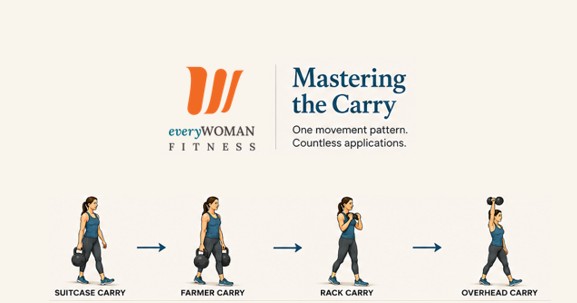
The Carry Family of Exercises
Carries are among the most functional strength exercises we can do. Learn how farmer, suitcase, front, shoulder, and overhead carries build strength and control while bringing the major strength families together.
The Carry Family of Exercises
Carrying things is about as functional as strength training gets.
We carry groceries from the car, haul bags through airports, pick up children, lug gardening supplies around the yard, and carry awkward objects that were definitely easier to buy than they are to get into the house. Carry exercises take this familiar task and turn it into strength training.
Unlike a squat, hinge, push, or pull, a carry may not look like much of a movement at first. You pick up a weight and walk with it. But maintaining your position while moving under load requires coordinated work from your hands and forearms, shoulders, trunk, hips, and legs.
Of all the strength families, carries have perhaps the most obvious connection to everyday function: pick up a load, control it, and move it from one place to another.
What Is a Carry?
A carry is an exercise in which you hold or support an external load while maintaining control of your body, usually while walking.
The weight might be held at your sides, on one side of your body, at your chest or shoulder, or overhead. Changing the position of the weight changes the demands of the exercise.
A heavy weight in each hand challenges grip and whole-body strength. Put that weight in only one hand and your trunk has to control an asymmetrical load. Move the weight to your shoulder or overhead and you change the demands again.
Research supports what we experience when we perform these exercises: loaded carries increase trunk muscle activity, and changing the load position changes how the body responds.
The Farmer Carry
The farmer carry is the simplest place to start.
Hold a dumbbell or kettlebell in each hand and walk.
It sounds almost too simple to count as an exercise, but add enough resistance and it becomes a substantial whole-body strength movement. Your hands have to hold the weight, your shoulders and upper back support it, your trunk maintains your position, and your hips and legs propel you forward.
The goal isn't to walk rigidly. It is to walk normally and under control despite the additional load.
This is also one of those exercises whose real-world application requires very little imagination. Carry two heavy grocery bags from the car and you're essentially performing a farmer carry.
The Suitcase Carry
Take away one of those weights and the exercise changes considerably.
In a suitcase carry, you hold a weight on one side of your body while walking. The uneven load creates a tendency for your trunk to lean toward the weight. Your trunk and hip muscles work to control that pull while you continue to walk.
That makes the suitcase carry a useful way to train strength and control under asymmetrical load.
And asymmetrical loading is everywhere in real life. We carry a suitcase in one hand, sling a bag over one shoulder, pick up a child on one hip, or carry a bag of dog food from the garage. Real life rarely distributes its loads perfectly between two hands.
Front and Shoulder/Rack Carries
Move the weight higher or farther in front of you and the challenge changes again.
A weight held at the chest or shoulders changes the relationship of the load to your body and the demands on your trunk and upper body. Depending on the variation, you might hold a single dumbbell or kettlebell at one shoulder, weights at both shoulders, or an object against your chest.
These positions also look a lot like things we actually carry. A box, laundry basket, bag of potting soil, or sleepy grandchild probably isn't going to hang conveniently at your sides like a pair of dumbbells.
As with suitcase carries, holding weight on only one side adds an asymmetrical challenge. The goal is to maintain control rather than leaning or twisting to accommodate the load.
Overhead/Waiter Carries
An overhead carry moves the load into a position that requires more from the shoulder and trunk.
With one or both arms overhead, you have to control the weight while the rest of your body continues moving beneath it. This makes the overhead carry a more advanced variation and one that requires adequate shoulder mobility and control.
Note that heavier isn't automatically better. A relatively light weight held overhead can provide plenty of challenge. For people who have the mobility and strength for them, overhead carries provide a way to integrate shoulder strength and control with whole-body movement.
To make this a bit spicier, you can combine different carry positions in one exercise, such as our Waiter Carry with Suitcase.
Marching Carries
You don't actually have to go anywhere to perform a carry.
Hold the weight in any of the positions above and march in place. You're still supporting an external load while repeatedly transferring your weight from one leg to the other.
This makes marching carries particularly useful for home workouts where you may not have 50 feet of open gym floor available. They also allow you to slow the movement down and focus on controlling the load as you shift from one leg to the other.
PT Perspective
One of the things I like most about carries as a physical therapist is that the exercise doesn't stop once someone can generate enough force to lift a weight: we also have to control loads while we move.
Walking while carrying weight adds demands that simply holding the same weight does not. Research comparing loaded carries with stationary loaded holds supports this: walking with the load produces different and, in several trunk muscles, greater muscular demands.
Carries also give us an enormous number of ways to adjust the challenge. We can change the amount of weight, where we hold it, whether the load is symmetrical or asymmetrical, how far we walk, and how quickly we move. We can even stay in one place and march.
That makes carries useful for something we value throughout our programs: progressively increasing the demands we place on the body while maintaining good movement.
Carries in Everyday Life
Carries may have the most obvious connection to everyday movement of any of the strength families.
A deadlift can help build the strength you use to pick a heavy bag off the ground. A carry trains what happens next.
You have to get that bag across the yard.
Or up the stairs.
Or through the airport.
Or from the far end of the parking lot because apparently that was the day everyone else decided to go to Costco too.
Carries let us practice something wonderfully ordinary: pick something up, control it, and take it where it needs to go.
References
McGill SM, McDermott A, Fenwick CMJ. Comparison of different strongman events: trunk muscle activation and lumbar spine motion, load, and stiffness. Journal of Strength and Conditioning Research. 2009;23(4):1148–1161. doi:10.1519/JSC.0b013e318198f8f7.
The Quantification of Muscle Activation During the Loaded Carry Movement Pattern. 2024. PMID: 38665162.
Anderson AM, Meador KA, McClure LR, Makrozahopoulos D, Brooks DJ, Mirka GA. A biomechanical analysis of anterior load carriage. Ergonomics. 2007;50(12):2104–2117. doi:10.1080/00140130701450195.